

Dad was released from hospital on Friday, on the condition that he has 24 hour care organised at home.
We have carers that come in every morning and every evening to get him out and put him to bed and a nurse to check up every day. He's incredibly stubborn and so is determined to come downstairs every day to the living room, but the toilet is upstairs so it means a rather scary ascent of the stairs. He's still dizzy and wobbly and incredibly weak.
Dad is of the opinion that his first dose of chemo hasn't made any difference, but I disagree - he seems a bit more stable and sometimes his speech is a lot better (it comes and goes), but I imagine sitting around all day drinking coffee from a sippy cup can't exactly feel like 'much better'.
He's back in hospital on Wednesday to see if he's any better and then he'll have chemo again a week after for another dose (I think).
He says I have to add "thank you for all the support and messages from all my readers - it has been a great comfort in a difficult time, as you can imagine"
Every day is a battle


An update
Sorry to hijack this blog, but after all of the lovely comments from readers I felt it was important to update you all on what was going on.
After some more inconclusive tests, the doctor down in Cornwall decided that it was better to start dad on chemotherapy ASAP, because he has been so weak they changed from their original plan of one type of chemo, a few weeks break then the other, to just giving him both types at once in order to get him on the road to recovery as soon as possible.
He started the chemo on Friday evening and I believe finished it yesterday or Monday. I spoke to him yesterday and although he complained of feeling no better, and that everything they gave him tasted funny, even the water, he sounded much more like his old self (he wouldn't believe me though!). After several weeks of struggling to understand him on the phone, he finally sounded much clearer again.
He's hoping to be out of hospital on Friday or Saturday, but it depends how his immune copes, and hopefully he'll be able to update you on his progress himself, but we'll have to wait and see.
Thank you again for all your kind words, it has meant a lot to all of us to know that so many people care.
Catherine
Harry Lamin 1921-1961
Written by Catherine, Bill's daughter:
After the war Harry went back to work at the lace factory. At this point Dad draws on his own memories of Harry. He describes remembering staying with him with his sister Anita and sharing a double bed, the smell of pipe smoke and playing with his hammer shot gun (a perfect toy for a 6 year old).
Anita recalls a Sunday afternoon where her grandfather woke up screaming with nightmares from the war. His mother claimed that Ethel had burnt all of Harry's letters, but fortunately it was only her own letters that she destroyed.
Dad's memories of his grandparents are rather vague since it was 40 years ago that his grandfather died, but he recalls walking to the gasworks for coke (for the fire) and lemonade from the little corner shop, which was a special treat that wasn't allowed at home. He says that in childhood every Sunday his grandparents would visit with fruit gums, pastilles and a bar of chocolate, items that had been rationed and so were still considered a big treat (Dad just asked whatever happened to Fry's 5 Boys Milk Chocolate?). He would walk to his grandparents house after school, as it was only a little bit further then going home.
Harry often frequented the horse racing, which his wife did not approve of, he went to Southall on the other side of Nottingham. Dad says that he doesn't recall if Harry ever particularly won, and as a child he is sure that any significant losses would have been kept from him.
One of the more interesting stories describes the move to Gordon Street from Mill Street. Harry was reluctant to move house, possibly because his home was one place where he felt safe after everything he had been through, so one day Ethel moved everything to his new home while he was at work. From Gordon Street, Dad recalls watching football out of the window, which is perhaps where his love of the game came from.
Even now, while struggling with his illness, Dad has said repeatedly that his grandad is a huge inspiration to him, while in hospital he said that one thing that kept him going was thinking about all the things Harry went through and yet remained strong.
I would like to finish with a quote from the book, made more poignant by the fact that whenever Dad has felt particularly unwell he has echoed his own grandfather's words:
"Harry retired at sixty-five in 1952, and lived until 1961, when he died peacefully at home. My mother, telling me of his death, reported that he said, 'I've had a good life'"
Apologies and Sad News
Dear all,
This is my first post on my father's blog. He has asked me to write to you all to update you with what's been going on for the last few months. As you have no doubt noticed, there has not been an update to the blog for a number of months; sadly this is because shortly after his father's death, Dad was diagnosed with a brain tumour. After a lot of trips to various hospitals he has been increasingly unwell and now struggles with the most simple things whilst remaining completely fine mentally so that he can't walk or talk some days, and he struggles to read and type, but he wants to be able to do everything and he can't. Obviously he is finding things very hard, but we remain optimistic about the future. In the last two weeks he has had a biopsy and although the results have come back as inconclusive, the samples have been sent to London for further examination. It is thought that he has a small tumour, but it is surround by lots of inflammed tissue which can be reduced by steriods, but that further treatment is required to get rid of the source of the problem; he is seeing a haemotologist on Monday to consider treatment options such as chemotherapy or radiotherapy. Unfortunately, during the biopsy there was a small amount of bleeding which has meant that he has lost all sense of balance and so is now struggling even more to be mobile.
Dad and I would both like to apologise for not updating the blog sooner in the year and we aim to work together to get as much written as we can both of Harry's journey and of Dad's own journey through this illness.
I thank you once again for taking an interest in our family's history,
Catherine
(Bill's middle child)
William (Bill) Lamin 1916-2010
Sadly, Bill, my father passed away yesterday afternoon, 30th December, aged 94. It wasn't completely unexpected, he has been very frail for quite some time.
Bill (Willie in the blog) was born 9 months before his father Harry was conscripted. He was one of main characters, frequently mentioned in Harry's letters. Click here for the start of Willie's story, in four instalments.
I am very sad that Bill was never really able to grasp how the blog worked. He certainly wasn't able to understand that the book was about his father.
Harry, from 1920
 Harry left the army in January 1920 (Note; he was, of course discharged from the Royal Munster Fusiliers - not the York & Lancaster Regiment) and was given a final payment of £61 2s 1d (£61.10) made up of almost £34 back pay and a £15”war gratuity"(an example of the military’s sense of humour, £5 a year for enduring unbelievable conditions), 4 weeks pay for leave (I was sure "furlough" was a U.S. term), ration allowance and a clothing allowance. From this £1 was deducted. Harry was allowed to keep his heavy army greatcoat for the journey home. If he handed it in at a railway station, he would get his £1 back. The £61 2s 1d was paid, by post, in three weekly instalments and was worth about £3,000 in today’s money. note; The paper that the Demobilization (surely, "Demobilisation" in England in 1920!) Account was printed on has disintegrated. I just did a jigsaw job on the scanner bed and then returned the pieces to the envelope. BL
Two related sites
I have been pleased to contribute to help others with similar material to get moving. Harry's blog and book has certainly stimulated several other similar websites particularly Dieter Finzen's "mirror image" German soldier's WW1 blog, Erich Rochlitzer's German WW 2 Blog and Sam Avery's WW1 "doughboy" blog. I am very proud to have initiated a new and exciting use for the internet. My one good, maybe great, idea.
This week two new publications been brought to my attention. Both are concerned with World War2 and, coincidentally, both concerned with life, not at the front, but back home in England during that war.
The first is a book and blog, "E.J. Rudsdale's Journals of wartime Colchester", edited by Cathy Pearson. E.J. referred to the futility of the slaughter in the war that ended 20 years earlier, on which to base his decision not to join up and fight. I can understand his viewpoint.
The second is May Hill's diary and poetry ;"The Casualties were Small" edited by Tom and Margaret Ambridge which was published as a book and now is being "blogged".
World War 1 from Above
A follower from the U.S. has informed me that the "World War 1 from Above" programme is available on YouTube and is well worth a look. In the supporting material, there is a very good account of the "Messines Ridge" battle that was part of Harry's war. The programme (it is English so I'm allowed the "correct" spelling) is split into four 15 minute sections and is of a good quality. Click on the links to view.
Part One
Part Two
Part Three
Part Four
Insight into Harry's World - TV Programme
The BBC showed ""World War One from above" on Sunday. It's still available on-line but probably only in the U.K. (Note the consequent careful spelling of programme - with 2 "m"s and an "e") .
A French aviator filmed the Western front battlefields from a balloon, shortly after the war ended. That filming was linked to well researched background material, with a particularly good account of the Messines Ridge battle, which Harry took part in. (Chapter 4 of the book - June 1917 in the blog).
The programme suggested that the Messines mines were set off sequentially, working to the south - that the Germans in the southernmost trenches watched with increasing horror as a vision of Armageddon approached. All accounts I've read indicated that the mines were fired simultaneously at precisely 3 am. ( I don't see any significant military benefit in a sequential system - with only seconds between detonations.) Does anyone have any more information?
Update. I'm reading Nicholas Rankin's excellent book "Churchill's Wizards". In it he describes "a rolling sequence that lasted an appalling 28 seconds". I don't know if that was the intention or the result of imprecise timings. Access to the orders for the attack, at army level, may be able to answer that one.
I found the whole programme to be excellent. Particularly chilling were the views of the water filled shell holes across the Passchendaele battlefield. Not just a few, the whole battlefield completely covered with, what looked from the air like puddles, but which were actually small lakes that would easily drown a man laden with military equipment.
This week, the blog should pass another milestone with the three millionth pageload. There are still over a thousand visitors a day with a steady flow of positive and rewarding comments.
Ideal Christmas Gift

To order, click on the link to the left. You can buy an unsigned copy or the audio version from Amazon UK.
World War 1 Ends Officially in 2010
Astonishingly, the final event of The Great War has taken place, 92 years after the end of hostilities. With the final installment of the reparations to be paid by Germany to France, the book can, finally be closed.
Follow the link for further details.
First World War officially ends - Telegraph
Willie -Installment 4 (to date)
 Bill, my father, is currently 94 years old. He’s very frail and has great difficulty with his memory. He lived alone after

 He has always been a keen fly fisherman, making regular fishing trips to salmon rivers. In the sixties, he bought a share in a fishing syndicate owning the rights to a stretch of the river Ecclesbourne, a beautiful trout stream in Derbyshire. I have been fortunate to have taken over his share and now enjoy the fishing whenever I am able. Bill was also keen on rough shooting. For many years he was member of a syndicate that had the game shooting rights over an area of Nottinghamshire, in the vale of Belvoir. I once remember him saying to me that he loved walking over the countryside but he really didn’t enjoy the killing of game. He then sold his gun and that was that.

 W. Lamin- Married to
Willie - Installment 3
It may seem obvious but, of course, I know more about each succeeding generation. If there's too much on Willie, just stop reading. BL
I’ll carry on with Willie’s story. (I think he’s about to turn into Bill)
Click on any photograph to see a larger version.
As I mentioned in the previous post, he had met a young school teacher, Nancy, at the amateur dramatics club. I think the “tree” character was “Heathcliffe” from Wuthering Heights, but can’t check. Nancy was teaching at Chaucer Street primary school which was the same school that Bill (Willie) and, probably Connie had attended as children. The school still exists, but has moved from the old buildings Bill and Nancy knew to a much more modern building.
Bill and Nancy were certainly together by August 1938. I have a lovely letter written to Nancy by Bill. Nancy was home in the English Lake District for the summer holiday.
 The romance was interrupted by the war. Bill enlisted in March 1940. In his army Pay book his occupation was recorded as “Buyer”. His place of birth and parents’ nationality were blotted out by the censor for obvious reasons. (I just can’t think what those reasons are at the moment.) He was in for the duration of the war (D of W in the pay book.) Has anyone any ideas what the "Approved Society" is? Or indeed what that space is for?
 I’m sure that the platoon picture is Bill’s equivalent of Harry’s squad picture from Rugeley. The legend on the back is ‘6 Platoon Recruits “A” Coy, Normanton Bks, 12/4/40. just under a month after he enlisted. I believe he joined the Sherwood Foresters, Notts & Derbys Regiment. The cap badge of the platoon Sergeant seems to confirm that. Normanton Barracks are in Derby, quite close to the old Derby County Football Ground, oddly named the “Baseball Ground”. Bill is 5th from the right in the middle row- next to the sergeant. A Sherwood Foresters battalion was adjacent to Harry's battalion for much of his service.
 In April 1941, Bill and Nancy married at Nancy’s home village, Greenodd in Cumbria. Bill’s army paybook records a fortnight’s leave a few weeks after my sister Anita was born in July 1943.
I think we’ve been a lucky family as far as military service is concerned. Harry survived unscathed and my military career was too short to be much of a problem. Bill tells that tale of being on parade, ready to board lorries bound for Southampton and a ship to the far east, when he was told to fall-out and pick up a rail warrant to Aldershot to join the Army Physical Training Corps.
His comrades arrived in Singapore just before it fell to the Japanese. In February 1942. At best, Bill would have ended up a prisoner of war.

So Bill got through World War 2, gaining a wife and a daughter and without seeing combat.
The next instalment will take us up to the present.
"Buy the book", link problem - Apologies
I've just discovered that the link to buy a signed copy of the book for the U.K. was corrupt and wouldn't work. Apologies if you've tried to buy one and been frustrated. (I thought sales had gone a bit flat!)
For the time being, I'll throw in a free set of "Harry" postage stamps as some form of compensation. No need to do anything. Just order a signed copy and the stamps will be included at no extra cost.
Click on the link on the left.
Willie (3) nearly ready to post. Certainly by the weekend.
Willie - Instalment 2 (Work in progress)
Click on any photograph to enlarge it.

 On the basis of his talents, he was offered a scholarship to one of the great Cathedral Choir Schools. His story is that his mother, Ethel, decided that such a course wasn’t “for the likes of them”, and the offer was declined.
 He played football (soccer), he was a goalkeeper. That was a revelation to me as I’m passionate about the game – and yet never knew that he played. I just discovered the photograph and asked about it. Cricket was his main sport and I can remember him playing for local teams when he was in his forties.
 Back to the singing. He tells the tale of how a well-to-do gentleman had left the request that Willie sing the beautiful “I know that my redeemer liveth” from Handel’s Messiah, at his funeral. At the time, Willie’s voice showed signs of breaking – a potential disaster. He was instructed by the choirmaster not to talk a word or to sing in the days leading up to the funeral. He even went to school armed with a letter of explanation. He made it, and received a treasured letter of thanks from the gentleman’s family.
 He was into amateur dramatics, meeting there a young school teacher, Nancy. I suspect the photograph of Willie leaning against the tree was a publicity shot. I hope so.
When he left school at 15, he was fortunate enough to find work in a local textiles company, run by an enterprising Dutch immigrant. He tells tales of collecting cheese from the Netherlands from the railway station and rolling it down the hill to the factory for the owner.
In 1940, Willie followed Harry into the army, initially as an infantry soldier, to take part in World War 2. (To be continued)
Willie - Instalment One
This is a tough one. For the last four years, I’ve never failed to upload any of Harry’s letters on time. I’ve managed to do enough research to put his experiences into a sensible context. Now, I’m finding it easy to put off writing the last two entries onto the blog. Maybe there’s an element of not wanting to end this wonderful journey.

 An important element in Willie’s life would be little Connie. She was six years older and suffered from cerebral palsy and so couldn’t walk. I don’t know how well she could talk, but Willie and Connie are reported as “good friends”. In 1918, Connie was sent away to boarding school in
 Update - and even more information on George
Apologies, I am struggling to finish off Willie's story. It's very difficult to write a sensible account about my father. Sister Anita has some information that she's sending to me to help.
Since Ken's correspondence, I've had even more information about George from Frances. (Frances, I'd like to thank you personally for your stirling efforts, but have no contact details.)
Frances wrote; Although George emigrated to Australia, he did come back to England for a time. He and his new wife, Nell, travelled on the Demosthenes, (there’s a picture of the ship on the Encyclopedia titanica website) and arrived into London on 4 April 1924. He was 27, and a bootmaker; Nell was 19. Their “country of last permanent residence” is unsurprisingly listed as Australia, but more interestingly, their “country of intended future permanent residence” is given as England. “Permanent residence” is defined as being “a year or more,” so they clearly intended to stay for some time.
Their address is given a 10 Geoffrey Street, Chorlton on Medlock, Manchester. Perhaps George came back to introduce Nell to the Laceys?
They seem to have stayed for about 5 years, as the next record is for their departure for Melbourne on 3 September 1929, aboard the Barrabool, (there’s a picture on the Photoship website) under Captain Sheepwash. This time, 2 year old Ken is travelling with them, having being born during their stay. George’s occupation at the time is recorded as “Salesman.”Meanwhile,
Ken knew little of his father's story and so has learned a great deal of his own family's history by following the blog.
Ken has emailed me with the following information;
"My Father George was a shoe maker by trade, as I understood from my mother and from my later observation.
George emigrated to Australia about 1921 and landed in Melbourne. He told me that his first job in Melbourne was with Dunlop Rubber, see Chas. Macintosh of Manchester, and opened a boot repair shop in the suburbs some time later. Also a member of the Lacey family, I guess a son, had already emigrated and opened a shoe repair shop elsewhere in Melbourne. Shoes were a family tradition! Close by near to that shopping centre lived the Tooth family, who would have known the Lacey’s, where I surmise my father would have met my mother to be, Nell Tooth.
Nell’s Father, son Fred and a younger son Sydney all served in the Australian army. The father was returned to Australia for health reasons and served as guard until 1920, Fred after training in Egypt went to France and went to action in the infamous battle of Fromelles on 19 July 1916. Over 3 days there were over 5,000 Australian casualties, including Fred who was wounded and managed to return. Brother Syd was posted to France in early 1917 and was wounded and declared unfit for action and returned to Aust July 1917. Fred, after more action in France, went into action in Polygon Wood and was killed on 26 September 1917. I guess Fred’s forces would have relieved Harry’s forces and George would have been about there according to the blog.
Arthur Lacey as Guardian is interesting. Again nothing was said by George and Nell referred to them as friends. I only became aware of Arthur’s role as executor of my fathers, although, we, as children, were well aware that he didn’t have a registered father."
Jack - John Ernest Lamin 1870 - 1945

Harry’s brother Jack was born in 1870 to Henry Lamin and his wife Sarah. He was 17 years older than Harry. In 1891, the census tells us that he is an assistant schoolmaster, living in Awsworth. We can only assume that he was teaching at the same village school that he attended as a child.
 I have quite a few photographs of Jack as his career progressed, but now, thanks to Frances, know little more of the detail of what happened to him. After some impressive research, Frances said...
On the 1911 census, he was living at 149 Church Street, Kimberworth. He was a lodger in the property, and living alone. His occupation is recorded as “Clerk in Holy Orders, Established Church.”
I consulted Crockford’s Clerical directory for various years, which gave me some more information on Jack’s career.
He went to St Catherine’s College in Oxford, where he got his BA in 1905. He was awarded his MA in 1916. By 1916, St Catherine's wasn't yet a "proper" Oxford College. It was set up to permit less affluent students gain a degree without the great expense of attending the University as a full undergraduate.
He became a deacon 1905, and a priest in 1906. From 1905 until 1911 he was Curate of Kimberworth, Rotherham. In 1906, his address is recorded as 98 Regent Street, Rotherham.
From 1911 – 1912, he was Curate at St Marks, Broomhall, Sheffield.
From 1913 – 1915, he was Vicar of Grimethorpe, Barnsley. His address (unsurprisingly) was the Vicarage.
From 1916 – 1923, he was Curate of St John, Newland, Hull. His address is recorded as 20 Ryde Street, Beverley Road. Hull. There is a reference in the East Yorkshire archives for St John’s dated 8 December 1916 which reads “Licence for assistant curate John Ernest Lamin.”
From 1923 – 1936, he was Vicar of North Dalton, again living at the Vicarage. North Dalton is small village south west of Driffield, in the East Riding of Yorkshire (where, coincidently, some of my ancestors lived).
From 1936 onwards, he was at Newton-on-Ouse, again in Yorkshire, this time north west of York. His address is the Vicarage. In 1938, he became the Officiating Chaplain at the nearby RAF Linton-on-Ouse. From June 1937 until April 1940, the Station was also home to Headquarters No 4 (Bomber) Group, which controlled the bomber stations in Yorkshire.
May 14, 2010

Thank you Frances. Fills many of the gaps. to my efforts. BL
By the 1901 census he was an “elementary schoolmaster” (Not an assistant) living in
By 1917 John had been ordained into the Anglican Church and was was a curate, a novice clergyman, living in Newland, Hull, Yorkshire.


Willie knew "uncle John" quite well and always referred to him in a respectful manner. Jack officiated at Willie, my father’s wedding, in 1941. He died in 1945 aged 75.
 Rugeley
 We made a mistake over the date of my birthday – we made it the 24th instead of 25th. Your pork pie came on the right day and we are enjoying it very much. We are expecting Bill on next Sunday. I hope we shall have better weather than it is (to)day for it has been snowing very heavily all day!
I can't really give a better picture of John Ernest Lamin. I have no access to anyone who knew him apart from Willie, and I'm afraid his memory gives us no help.
More information from blog follower Veda.
The remaining piece of information missing from your added comment to the blog is that he was Canon and Prebendary of Husthwaite from 1940.
"Prebendary" means that he was given this honorific title as a senior parish priest. The connection with Husthwaite will have been non-existent, and simply a random title which became vacant and which the cathedral Chapter decided to bestow on Jack. In the medieval period it seems to have been fairly significant, with legal jurisdiction:
Link to guide 1
Link to Guide 2
Although some canons have a specific role in relation to a cathedral which means that they live in cathedral houses and are part of the cathedral's day-to-day life, a canon with a title like Jack's had been given this office pretty much as an honorary distinction in recognition of long and faithful service. He might have been involved in some of the Minster's business as member of a council or committee, and may have been invited to preach very occasionally. As you said of his Oxford degree, well done Awsworth!
Thank you, Veda.
I'm really grateful that Jack kept Harry's letters safe so that they could be handed on to Ethel. Followers of the blog owe much to him and to Kate.
Photographs and images (Click to enlarge)
There are no dates with any of the pictures so the reader can make their own judgement. The only exception is the last photograph, taken at Willie's wedding to my mother, Nancy Satterthwaite, in 1941.
Thanks to readers' efforts and the Church of England's detailed records, we seem to have arrived at a good account of Jack's career.
The next post - Willie
Catherine Lamin (Kate) 1876 -1948
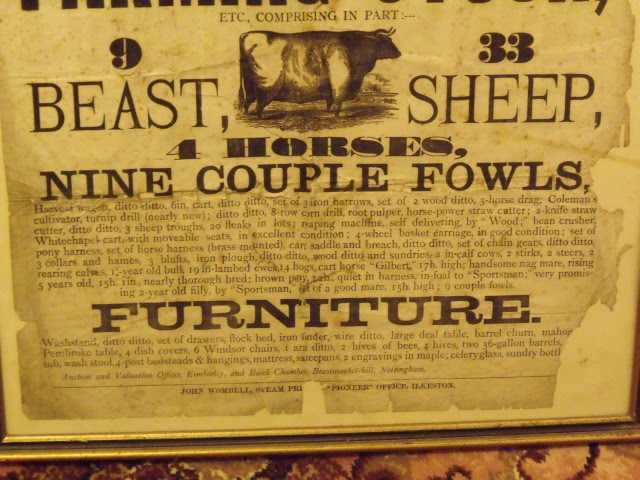
Harry’s sister Kate was born on 22nd April 1876, the year after the family sold the “New Farm” at Annesley, about 8 miles (5km) North of Awsworth.
 On the birth certificate, her father, Henry, still recorded his occupation as a farmer, but by the 1881 census he had accepted the status of farm labourer.
 We can see at the 1881 census that the family was living with Harry’s grandmother, the widow Sarah Brown (evidently she must have lost two husbands).

In the 1891 census, the family, now having lost their mother, was still living in Awsworth in Towsons Row. (Farmer Towson – farmer of 54 acres - lives at number 1). Catherine, called Kate on the census, has no recorded occupation but, at 14, was probably occupied in looking after 3 year old Harry.

I have no further information about Kate until the 1901 census. In the intervening time, she would have been helping to bring up Harry and will have endured the loss of her elder sister Mary Esther who was 17 when she died in 1889.
By 1901, Kate was living with her father in a different house, this time in Kimberly Lane Awsworth. We know that Annie was in service and Harry was living with brother Jack, now a school teacher in Oxford. She has no recorded occupation. Her father Henry, was a chemical labourer.
Still nothing more that I can find until 1910 when Connie was born. Catherine’s occupation was recorded on the birth certificate as a school teacher. I had always assumed that Connie was the result of some youthful indiscretion – or perhaps some “gentleman” had taken advantage of her youthful inexperience. Of course, at 34 years of age, neither was the case. Connie was born at 145 Nottingham Road Ilkeston, I believe it was where sister Annie lived later, maybe then. The only clue as to the father’s identity is Connie’s middle name - Constance Wilkinson Lamin.

By 1913, Kate had moved to London and had become a qualified midwife. I have no information about what happened to Connie. Ethel and Harry weren’t married until March the next year. 24th January 1913, “Kate Lamin entered the service of the Guardians of the Poor of the Parishes of St GILES-IN-THE FIELDS AND ST GEORGE, BLOOMSBURY, as Midwife”. She was described as “A qualified and certificated midwife. Kind and considerate to her patients.”
 Her employer changed their name on amalgamation to the Holborn Union. In November 1916 became Kate became a Health Visitor, becoming qualified as an “Inspector of Nuisances” by taking an examination mentioned by Jack in a letter to her at that time. (Coincidently written on the same day that Harry took his first examination as a front line soldier at the battle of Messines Ridge.)
 A testimonial written in October 1917 confirms that she resigned from the London job and moved 200 miles North to Leeds in Yorkshire. I’m not too sure about the detail, but the family story is that she worked at Leeds Infirmary and, eventually, became a Matron there. Maybe. She certainly left Connie behind with Ethel and Harry in Ilkeston.
 Then we lose track of her. She appeared for Connie’s funeral in 1929, as she registered her death. We can see her at Willie and Nancy’s Wedding at Greenodd, North Lancashire (now Cumbria) in 1941. Her last will and testament was signed in 1946, before her death in July 1948 aged 70. She was buried in the same grave as her daughter Connie in Ilkeston Cemetery.
The family always referred to her in quite respectful terms. I got the impression that she was quite well off, if not wealthy. My sister Anita, who hadn’t quite reached her fifth birthday when Kate died, can remember her. She recalls “a formidable woman.”
Pictures (Click on any picture to enlarge) From the top.
1. The poster for the farm sale 1875.
2. Kate's cross-stitch sampler produced at Awsworth Board School.
3. Funeral cards for Harry's mother and sister, Mary Esther.
4. Employment record for her London job.
5. Wonderful velum certificate "Inspector of Nuisances".
6. A studio photograph of Kate in her nurse's uniform.
7. On holiday in Blackpool in 1925. (Actually, on holiday in front of a picture of Blackpool!)
8. Kate at Willie's wedding to Nancy 1941.
More news.
Marek Vašut has approached me asking if I would mind if he produced a Czech version of Harry's Blog. Mind? I'm delighted.
Marek has made a start and his initial efforts can be found Here
Finding that the current version of audio book is not available outside the European Union, I am recording readings of each of Harry's letters. This, rather than an audio version of the whole book, could act as a companion to the book.
I should have the right sort of accent as I was born and brought up in the same town as Harry. Watch this space for details and availability.
